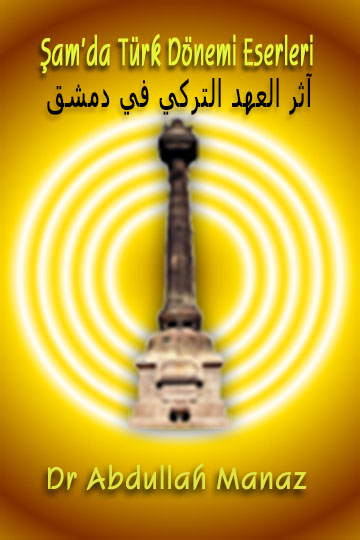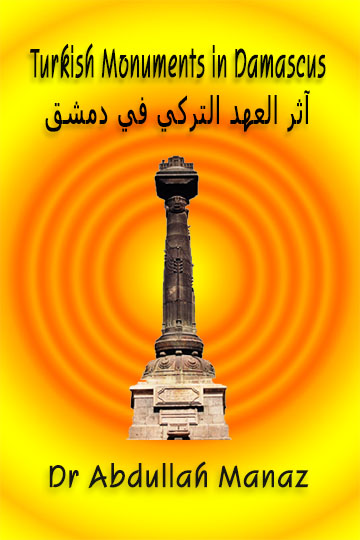




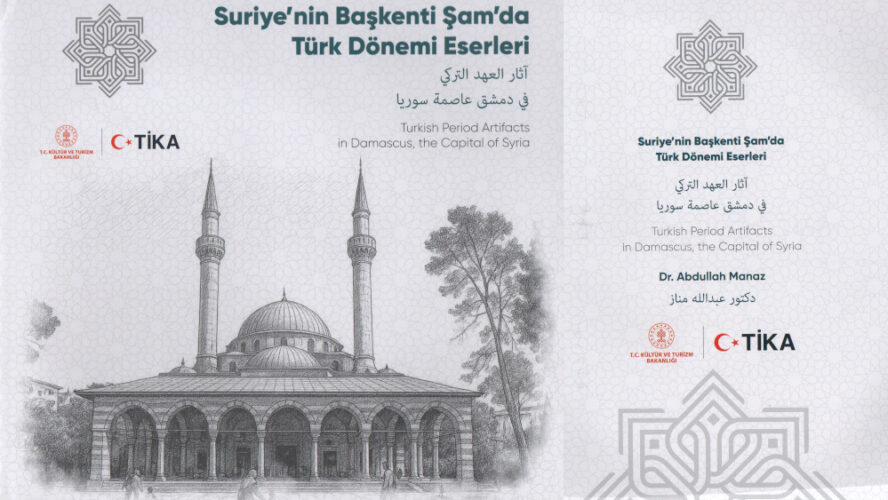

Abdullah Manaz’s book, “Turkish Period Artifacts in Damascus, the Capital of Syria” was published in Turkish, Arabic, and English by TIKA (Turkish Cooperation and Coordination Agency).
First of all, I must state that: This work is not an Art History work or a Photo Album. This is a Documentary Photography Work.
When I went to Syria as a member of the Turkish Radio and Television Corporation to study Arabic, they said that there were only a few Turkish works in Damascus. In addition, Hafez Assad and the Baath regime claimed that “Turks were colonialists who exploited these lands for hundreds of years.” I explored every street of the Old City of Damascus for about a year, step by step, and discovered more than a hundred architectural works from the Turkish period. I marked them on a map of the old city and took their photographs.
During this period, it was very dangerous for a foreigner to take photographs. You could be arrested without being interrogated and thrown in jail. I took photographs for days without attracting the attention of the security forces. There were no digital cameras in those years. There were cameras that used film. I took the 7-8 films I shot in the first few months to a photography shop and asked to have them developed. A week later, all my films were returned to me burnt. I learned that the Syrian Intelligence Service was directly informed about the film that foreigners brought. After that, I started to collect the film of all the photographs I took. When I was returning to Turkiye, the Military Attaché of the time, Mr. Esad Arslan, helped to bring them to Turkiye without any problems.
It was very difficult to take photographs with these cameras. You had no chance of seeing the result and quality of the photograph you took. When taking photographs, you had to take into account the sun, shadow, darkness, temperature and the location of the historical artifact. In addition, most mosques are closed outside of prayer hours. Some important historical buildings are forbidden from taking photographs because they are government buildings. The doors of some historical buildings have been locked. I tried to choose the best ones from the hundreds of photographs taken under all these difficult conditions. I determined the dates of the historical artifacts from their inscriptions. However, I may still make mistakes.
I am very happy about this. I documented that Damascus is a Turkish city and fell in love with this city. I wanted to go back and continue my research for years, but this was not possible due to the Middle East wars and the Baath regime in Syria.
The revolution in Syria in December 2024 was a historic turning point. Attempts to turn Turks and the Syrian people into enemies were thwarted. A great bridge of friendship and peace was established between Turkiye and Syria. This beautiful beginning between the two countries will probably end the conflict and chaos that has been going on for years in the Middle East.